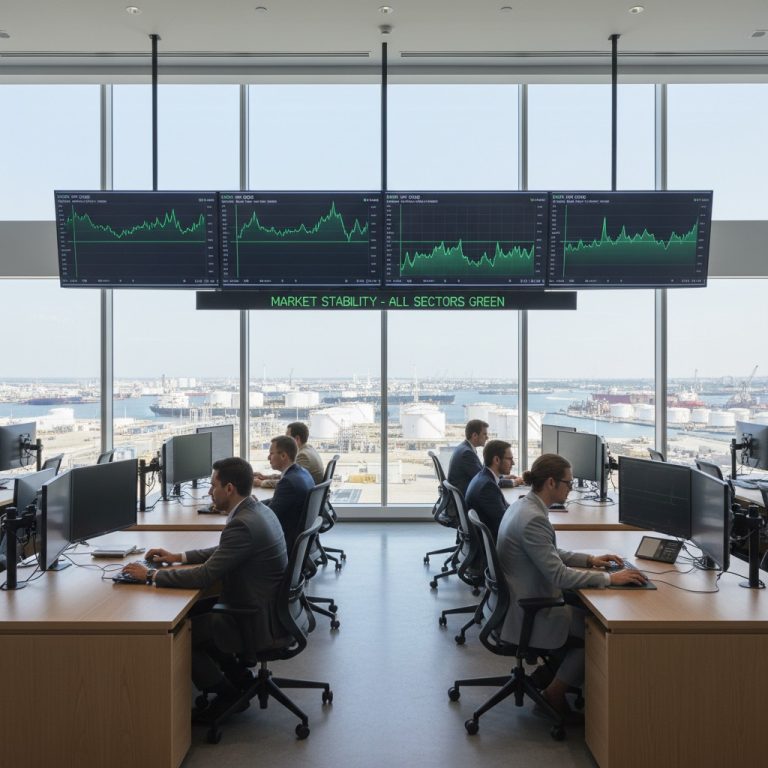
Low conviction is often mistaken for pessimism. In today’s oil market, it means something else entirely.
Prices have been relatively stable despite a year marked by surplus, geopolitical tension, and policy shifts. What has changed is not interest in oil, but how investors choose to engage with it. Restraint has become deliberate.
Positioning That Speaks Quietly
Data through late 2025 and early 2026 show hedge fund net-long positions sitting near multi-year lows, even as Brent traded comfortably in the mid-$60s. This is not a market abandoning oil. It is a market refusing to pre-commit.
In practical terms, this shows up as:
- Smaller position sizes
- Faster profit-taking
- Less tolerance for holding risk without confirmation
Investors are present, but they are waiting for proof.
The Curve as a Conversation
The futures curve tells a similar story. Backwardation flattened steadily through late 2025, and at times the front of the curve flirted with contango. In past cycles, that shift might have been read as weakness.
Today, it reads as patience.
Contango rewards time. It signals that storage is available, inventories are manageable, and urgency is limited. Rather than chasing spot prices, participants discuss carry, storage economics, and optionality. The curve has become a planning tool, not a verdict.
Why Rallies Struggle to Last
Short-term rallies still occur. They did in January when geopolitical tensions briefly pushed Brent toward the low $70s. But without deep, long-term positioning behind them, those moves faded quickly once risks eased.
You could feel it in the market:
- Prices moved, but follow-through was thin.
- Buyers hesitated to add exposure.
- Attention returned quickly to inventories and flows.
Momentum without commitment has a short shelf life.
Fundamentals Take the Lead
As financial conviction steps back, physical fundamentals step forward. Inventory levels, refinery runs, and storage trends now anchor price expectations more consistently than narratives.
Large global stockpiles and visible floating storage have repeatedly capped upside moves. When barrels are available and trackable, stories alone struggle to sustain prices.
What This Signals About the Next Cycle
From my experience working across economic coordination and international energy frameworks, phases like this are often misunderstood. Low positioning is not disengagement. It is discipline.
Caution has become a strategy. Investors are not betting against oil. They are insisting on evidence before committing capital. When markets behave this way, price discovery becomes quieter and slower, but often more durable. The next cycle will not be driven by fear or enthusiasm alone. It will be shaped by proof.